Thai rice sector must rethink strategies

Thailand’s rice sector faces rising global competition, pressured by India’s export return, Vietnam’s cheaper fragrant varieties, high hom mali prices, and low yields. Exporters urge diversification, new fragrant varieties, higher productivity, and stronger public–private collaboration. The Khaopraneat project aims to create premium, region-specific rice products to expand markets and retain competitiveness.
As competition in the global rice market rises, Thailand must redesign its strategies to maintain market share and explore new frontiers.
Lisa Sriprasert, vice-president of operations at Riceland International, a Thai rice exporter, noted several factors impact shipments, including the resumption of India’s rice exports and the baht’s recent appreciation.
“Everyone is monitoring India’s rice export strategy. If the country decides to flood the market with rice, we could see a sharp decline in white rice prices,” she said.
Mrs Lisa said the price of white rice has decreased in recent months due to a global market surplus, but Thai hom mali still secures high prices. However, it is facing increasing competition from Vietnam’s fragrant rice.
She noted Thai hom mali rice remains the top choice of US consumers, with sales consistently rising despite high prices.
Meanwhile, Vietnam has captured a substantial share of the Thai fragrant rice market by providing varieties at more affordable prices, which appeal to most consumers.
For the 2025/26 crop, Thai hom mali rice is UScopy,120 per tonne and Pathum Thani fragrant rice is $680 per tonne, while Vietnam’s fragrant rice is $460-900 per tonne, depending on the variety, according to the Thai Rice Exporters Association.
“High prices for hom mali rice could result in negative consequences, especially when economies across the globe are weak. The market share of very pricey rice will decrease as consumer purchasing power weakens,” said Mrs Lisa.
She said Vietnam has a different strategy, producing soft fragrant rice at accessible prices with a focus on volume.
MORE VARIETIES
Mrs Lisa said Thai rice authorities are trying to promote a wider variety of fragrant rice, but it is difficult because hom mali is still the most recognised variety, and there is a hesitance to lower its price.
“Industry executives know offering other varieties of fragrant rice is essential for Thailand’s survival in the market. While the reputation of Thai rice remains strong, the brand’s legacy is fading,” she said.
Mrs Lisa said Thailand needs other varieties to compete in the fragrant rice market.
“We must find alternative varieties to compete with Vietnam and target slightly lower-priced market segments. If we want to generate more income for the country, we must serve a broader market, rather than focusing solely on high-priced hom mali rice,” she said.
While advocating for greater diversity in fragrant rice offerings, Mrs Lisa cautioned against overwhelming consumers with too many choices.
“Having too many varieties can confuse customers, and the volume can shrink. For example, to export 100 tonnes of rice, about 200 rai of land is necessary. Large volumes are essential for competitiveness,” she said.
YIELD IMPROVEMENT
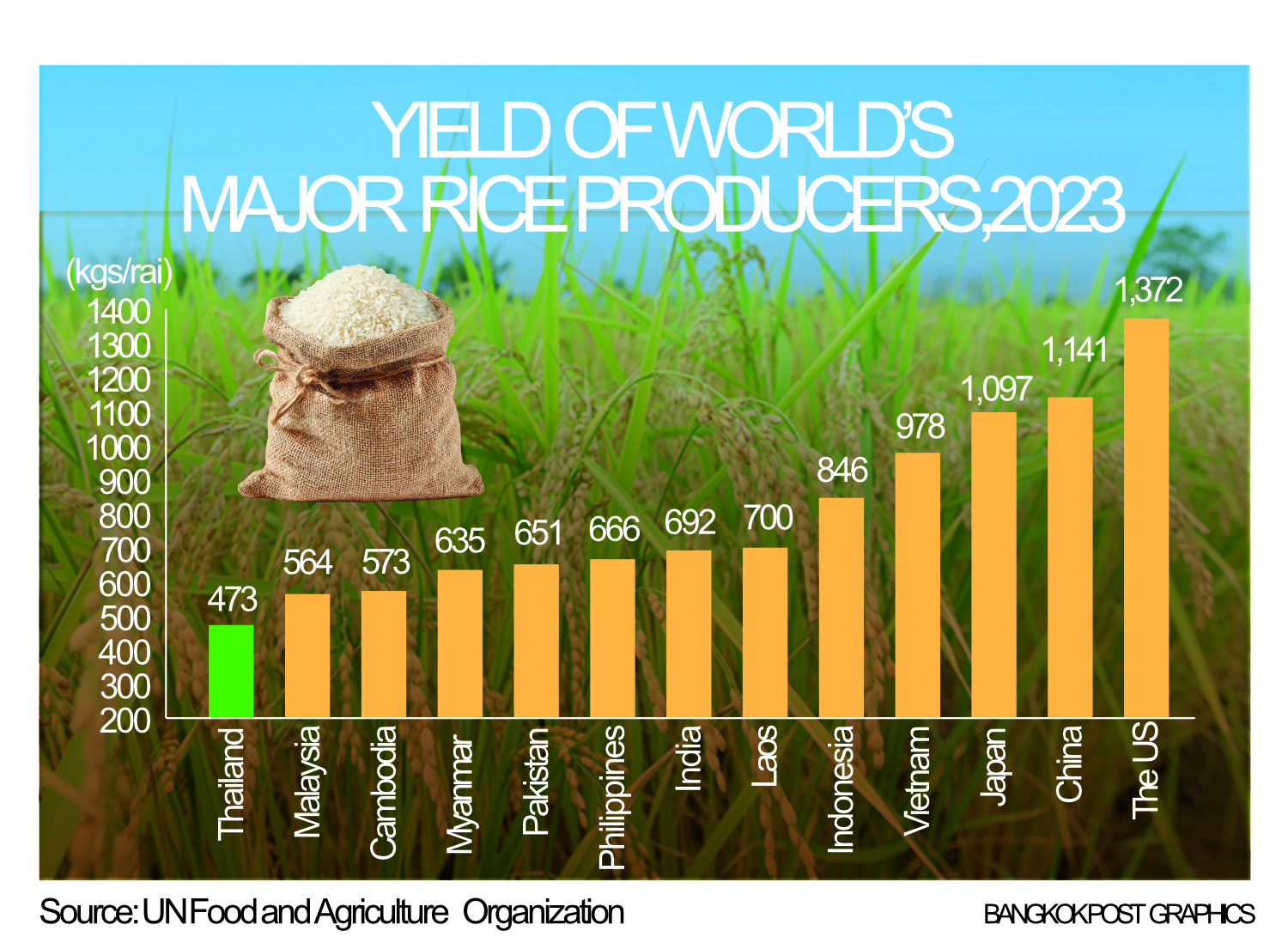
Thailand has the lowest rice yield per rai among the world’s top rice-exporting countries, said Mrs Lisa, citing it as a major weakness that must be improved.
According to the UN Food and Agriculture Organization, Thailand’s average rice yield is 473 kilogrammes per rai, while Vietnam’s yield is 978 kg per rai and India’s is 692 kg.
She said hom mali rice is a traditional variety, cultivated for many years, and its yield cannot be increased if it is to maintain its identity.
“Selling hom mali rice requires DNA testing to ensure its purity. If it fails the test, it cannot be sold,” said Mrs Lisa.
“To tackle this challenge, we could explore developing new varieties by cross-breeding high-yield varieties with hom mali. This could produce a new fragrant rice with hom mali-like qualities, but higher yields.”
NEW SEGMENT
Regarding the survival strategy of the Thai rice industry, Nop Dharmavanich, co-founder of Rice Hub, a community of rice growers and related parties, said Thailand must create high-value products that stand out through unique flavours, careful cultivation practices and strong promotion.
To achieve this objective, the Commerce Ministry initiated the Khaopraneat project to promote Thai rice in a new segment.
This project focuses on selecting the best rice varieties for each region, on careful cultivation practices and on the unique flavour and texture of each variety.
The scheme seeks to elevate Thai rice from a common commodity to a cultural product with distinctive flavour, identity and value.
He said today’s consumers care about their eating experience and health.
“Consumers are willing to pay for the taste and quality of rice,” Mr Nop said.
He said some varieties are sold at 120 or even 200 baht per kg, which are favourable prices for farmers.
For this segment, organic cultivation ensures consumer safety, while some varieties with geographical indication certification underscore their unique identities, opening up new markets for Thai rice, said Mr Nop.
The project aims to create a new market by bringing together 700-800 rice producer groups across the country.
The first 200 groups will participate in a quality enhancement initiative designed to foster connections between local and global markets, said caretaker commerce minister Suphajee Suthumpun.
These groups will receive support to showcase the unique qualities, flavours, identities and stories of their rice varieties. The objective is to elevate consumer awareness and attract international buyers, who will be encouraged to select Thai rice as deliberately as they would choose coffee or wine.
Furthermore, networks including hotels, restaurants and chefs will be invited to join in choosing rice varieties for their culinary creations, adding value to the offerings.
Mr Nop said since the project’s launch, business-matching initiatives have been organised, such as pairing restaurants with rice farmers.
He said there are efforts to encourage the use of these rice varieties as ingredients in other food products, such as yogurt, ice cream and chocolate.
STRONGER COLLABORATION
To navigate and maintain competitiveness in the global market, Mrs Lisa said Thailand needs strong collaboration between the public and private sectors with a common goal.
“Thailand has a wide variety of rice, but lacks coordinated actions among seed producers, farmers, millers and sellers, primarily due to insufficient volume,” she said.
“Although research is available, each researcher tends to push their own agenda without real collaboration, so efforts never scale up.”
Mrs Lisa said with enhanced collaboration combined with a focus on diverse rice varieties and effective irrigation, Thailand’s rice industry could be in a much better position.
“If we want to penetrate new markets, we should target countries where Thailand has not yet sold rice, particularly those with high potential such as South Korea and Saudi Arabia, as well as other difficult to access markets where government support is needed to help negotiate access,” she said.
To Read more about Rice News continue reading Agriinsite.com
Source : Bangkok Post