State-wise sugar quota for sale during the second fortnight of October 2026

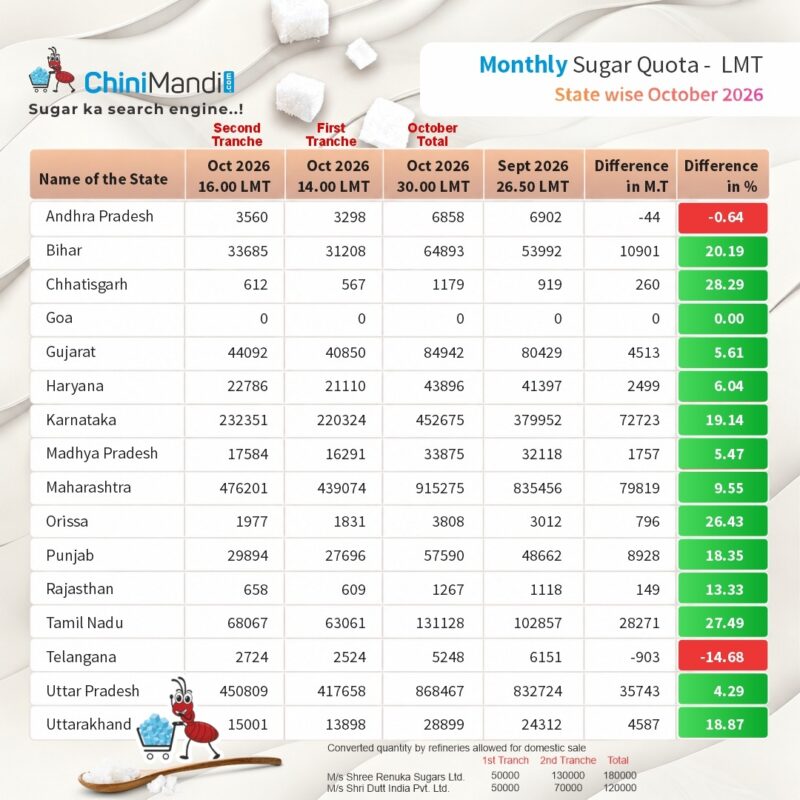
India’s Food Ministry allocated a sugar sales quota of 16 lakh metric tonnes for the second fortnight of October 2026 to 587 mills and two refineries. Maharashtra received the largest allocation at 4.76 lakh tonnes, followed by Uttar Pradesh at 4.51 lakh tonnes and Karnataka at 2.32 lakh tonnes.
In a notification released on October 13, the Food Ministry allocated a fortnightly sugar quota of 16 lakh metric tonnes (LMT) for second fortnight of October 2026 to 587 sugar mills and two refineries.
For first fortnight of October 2026, the quota allocated for sugar mills was 14 lakh metric tonnes (LMT), while September 2026 the government had allocated a total monthly sugar quota of 26.50 LMT, consisting of 13 LMT in the first fortnight while for the second fortnight, it was 13.50 LMT.
In October 2025, the government had allocated a monthly sugar quota of 24 LMT for domestic sale. while in October 2024, the sugar quota released for sale was 25.5
In September 2025, the government had allocated a monthly sugar quota of 23.5 lakh metric tonnes (LMT) which was similar to the quota allocated for September 2024.
In August 2026, the government had allocated a monthly sugar quota of 22.5 lakh metric tonnes (LMT) which was equal to the quota allocated for August 2025.
This is the fourth fortnightly allocation which comes as the government continues to regulate sugar availability in the domestic market through periodic sales quotas.
The quota mechanism is aimed at ensuring adequate sugar availability and preventing sharp fluctuations in domestic prices. Market conditions and demand will remain key factors in determining sugar prices during September.
According to the order, Maharashtra received the largest share at 4,76,201 tonnes, followed by Uttar Pradesh at 4,50,809 tonnes and Karnataka at 2,32,351 tonnes. Tamil Nadu was allotted 68,067 tonnes, Gujarat 44,092 tonnes, Bihar 33,685 tonnes, Punjab 29,894 tonnes, Haryana 22,786 tonnes, Madhya Pradesh 17,584 tonnes and Uttarakhand 15,001 tonnes.
Among the smaller producing states, Andhra Pradesh was allotted 3,560 tonnes, Telangana 2,724 tonnes, Odisha 1,977 tonnes, Rajasthan 658 tonnes and Chhattisgarh 612 tonnes. In addition, Shree Renuka Sugars Ltd was permitted to sell 1,30,000 tonnes and Shri Dutt India Pvt Ltd 70,000 tonnes of converted sugar from their refineries in the domestic market during the fortnight.
The order also allows mills that begin crushing in October 2026 to sell the sugar they produce during that month in October and November 2026.
Under the fortnightly quota, mills must sell at least 45 per cent of their allocation in the first week and the rest in the following week, the department said. Sugar sold must be dispatched from the mill within seven days, and the date of sale will be counted as the date on which the mill generates the sale invoice.
Mills have been asked to submit complete sale details for the period up to October 15 by October 18, 2026, through their registered email IDs. The order warned that mills failing to comply may not be given any release for November 2026.
The department has also directed mills to ensure that their dealers register on the DFPD portal and declare their sugar stock every Friday. It reiterated that no mill may sell sugar to an unregistered dealer, and mills must certify this through an undertaking when filing the P-II form. Login credentials for verifying dealer registration were shared with mills through a letter dated August 27, 2026.
Mills must file the monthly P-II return for October 2026, covering both fortnights, through the application programming interface (API) by November 7, 2026, and the mill-wise quota for October is being uploaded on the department’s website for reference. Closing stock declared as on September 30, 2026, will be checked during physical stock verification, and any mismatch will be treated as a violation of the Sugar (Control) Order, 2025, read with the Essential Commodities Act, 1955.
Group companies with more than one sugar unit may maintain stock either unit-wise or for the group as a whole, the order said. Mills must also comply with the mandatory packaging of 20 per cent of sugar in jute bags under the Jute Packaging Material (Compulsory Use in Packing Commodities) Act, 1987, and report it in the P-II proforma on the National Single Window System (NSWS) portal, with the department cautioning that any non-compliance will be dealt with under the Essential Commodities Act.
To Read more about Sugar Industry continue reading Agriinsite.com
Source : ChiniMandi