French wheat production rebounds after a difficult 2024

France’s 2025 wheat harvest rebounded to 33.4 million tonnes, with yields 7% above the five-year average. Exports to non-EU countries are projected at 7.7 million tonnes, mainly Morocco and sub-Saharan Africa. Ending stocks may reach 4 million tonnes, the highest in 20 years.
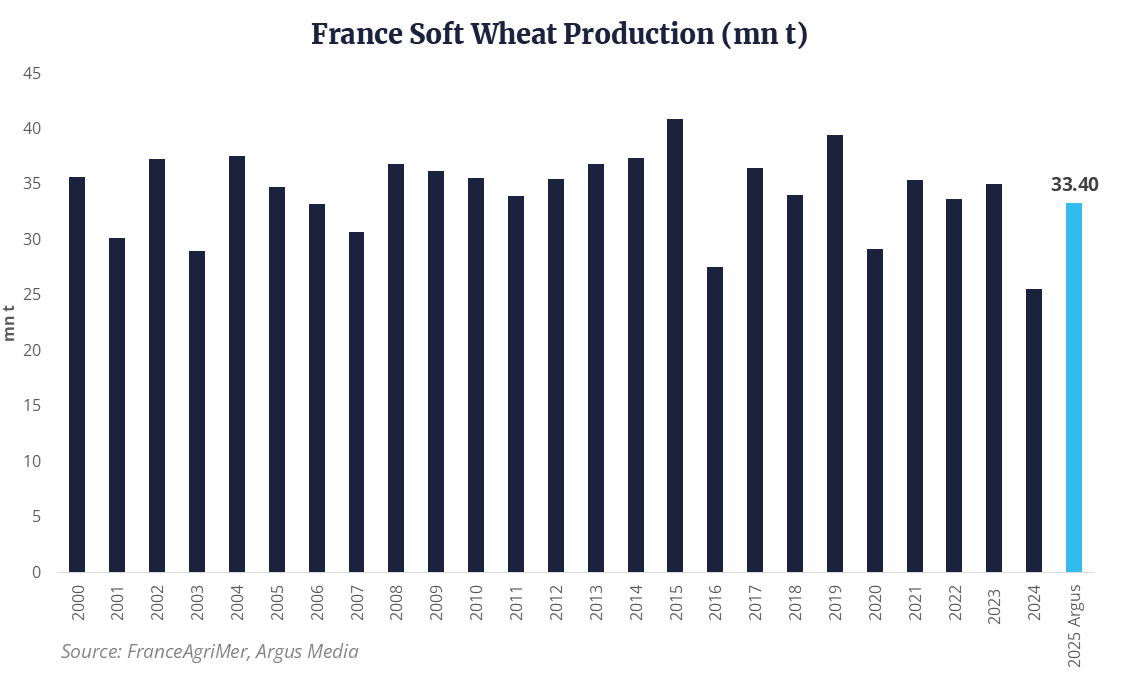
In 2025 the French wheat harvest bounced back close to the five-year average, reaching 33.4 mn t, according to Argus. This marks a strong recovery compared with the disastrous 25.6 mn t produced in 2024.
Persistent winter rainfall initially raised fears of another poor season. However, favourable weather in spring 2025 allowed excellent flowering, resulting in an estimated yield of 7.44 t/ha (hectares), which is 7pc above the five-year average. Despite reduced sown areas, this improved yield restored French wheat production to normal levels.
Export challenges amid global oversupply
While availability has surged and quality remains high, exports are the key challenge for French wheat. Historically around 50pc of French wheat is exported, with a large share going to non-EU countries.
However, one of France’s long-standing key partners, Algeria, has withdrawn from purchases from France since 2023 due to deteriorating diplomatic relations. Similarly, China, a major importer of agricultural commodities between 2019 and 2024, has significantly reduced its grain purchases and has withdrawn from the international market.
In this context, French wheat has no choice but to attempt to remain competitive against other major exporting countries to secure a place on the global market, at a time when global availability has reached historic levels. The pressure on wheat prices is therefore strong to maintain this competitiveness.
Argus forecast: 7.7 mnt of exports
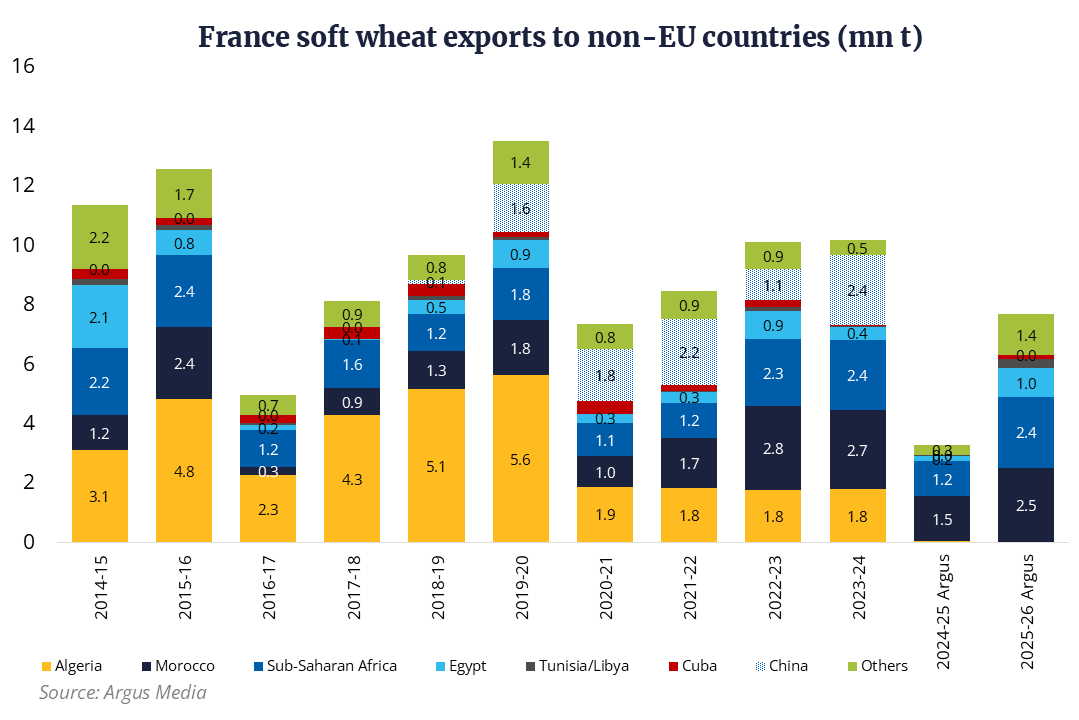
Against this backdrop, Argus forecasts French exports of 7.7 mn t for 2025–26, with Morocco (2.5 mn t expected) and sub-Saharan African countries (2.4 mn t) as the main trading partners.
Exports during the first months of the season are in line with expectations, reaching 3.4 mn t to non-EU countries by mid-November, representing 44pc of the season’s target.
French wheat will however need to remain competitive to sustain flows until the end of the season, as Russian exports gain momentum and volumes from the southern hemisphere are expected to enter the market soon. Argentina, in particular, could become a serious competitor in the second half of the season, with record yields and a slightly lower protein content than usual.
Argentina could challenge French milling wheat, which has a protein level of 11-11.5pc, especially for Morocco, which remains France’s main partner. This situation underscores the importance for France to maintain attractive pricing to preserve its market share.
Stocks expected to hit 20-year high
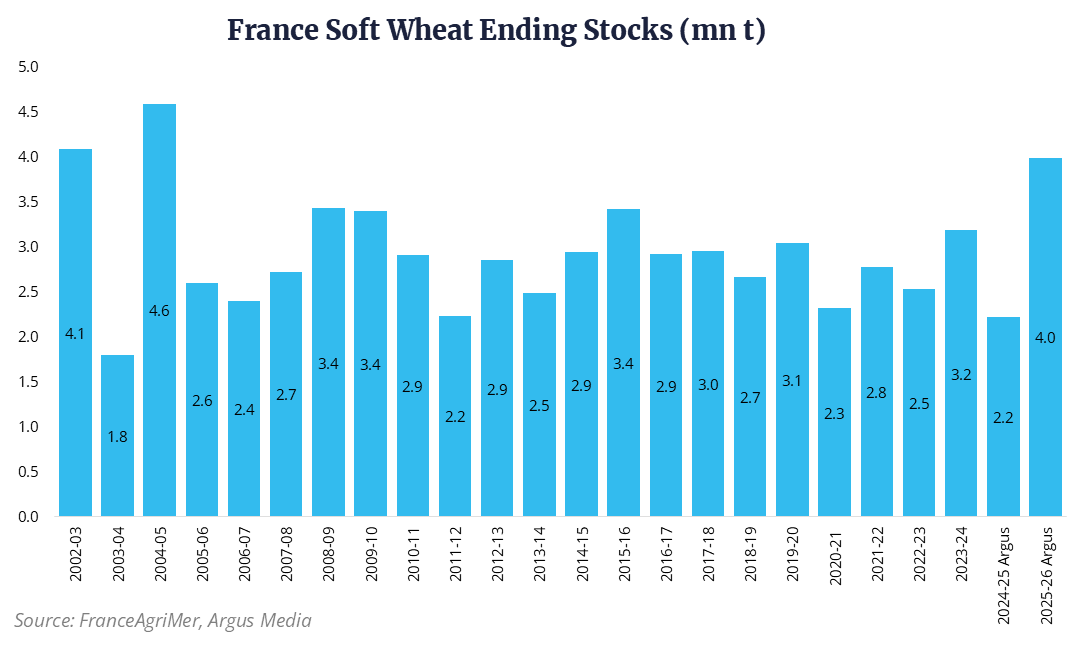
Despite the strong early export performance and a target of 7.7 mn t to non-EU countries, a significant increase in French wheat stocks is expected at the end of the season. Argus currently estimates ending stocks at 4 mn t, which would be the highest level in over 20 years. Domestic consumption remains broadly stable, and while intra-EU exports and the rebound in non-EU exports help, they do not offset the expected surplus. We are therefore facing a season which profoundly restructures stocks and weighs on the French balance sheet, highlighting the importance of managing wheat flows in the coming months.
Looking ahead: 2026 crop outlook
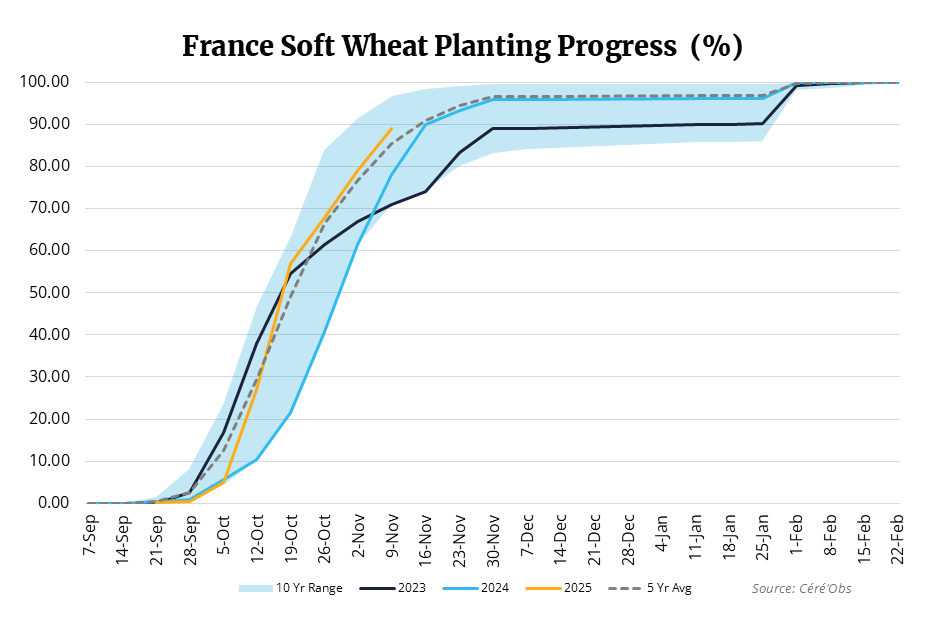
These large stocks will automatically carry over into the new season. Attention is increasingly turning to sowing and crop development for the 2026 harvest. According to Cere’obs, sowing is almost complete, with 89% of wheat areas planted as of 17 November 2025. Unlike last year, sowing has proceeded without major incident and remains ahead of previous seasons. Argus estimates French wheat acreage at 4.69mn ha in 2026, compared with 4.49mn ha last year, returning above the five-year average of 4.63mn ha. Conditions are currently optimal, with regular rainfall and favourable temperatures, and will need to be monitored throughout the crop cycle. Spring will once again be a key period for yield development. However, another increase in French production in 2026 would add to the ending stocks from 2025–26, raising questions about exports and market opportunities for French wheat.
To Read more about Wheat News continue reading Agriinsite.com
Source : Argus