Philippines: Rice Crisis Looms as Super El Niño Threatens Supply in 2026


The Philippines faces a looming food security risk in 2026 as rice import projections diverge sharply. A potential Super El Niño, rising input costs, and weak buffer stocks could push imports to 6 MMT, increasing dependence on volatile markets and threatening supply stability, prices, and national food security.
A critical food security challenge in 2026 looms over the Philippines, as projections for rice imports diverge widely amid the Super El Niño 2026 forecast and other other factors. While the Department of Agriculture estimates 3.6 to 3.8 MMT, assuming record palay output of 20.3 MMT, the U.S. Department of Agriculture projects rice imports at 5.1 million metric tons (MMT).
Such a gap reflects the difference between international risk-adjusted forecasting and domestic production targets.
A forecasted Super El Niño from June to December 2026, elevated fertilizer and oil prices linked to the ongoing war in the Middle East, and the absence of a guaranteed Minimum Support Price (MSP) for farmers suggest both projections may underestimate risk.
Factoring in El Niño and global shocks, imports could rise to 5.5 to 6.0 MMT. Without decisive action, the country risks deeper import dependence, rising prices and broader stability concerns.
Food security must be treated as national security. Asean peers integrate buffer stock systems into defense strategies, while the Philippines remains exposed. A Rice Emergency Proclamation could stabilize supply and prices, protect farmers and signal that government is prepared to defend food security as vigorously as territorial sovereignty.
- Palay output could fall to 17 to 18 MMT, erasing recent gains
- Fertilizer and oil shocks could inflate production costs and consumer prices
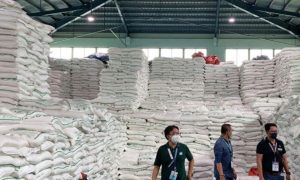
- National Food Authority (NFA) reserves cover only seven to 15 days of consumption, far below ASEAN peers
- Imports could rise to 6.0 MMT or more, increasing exposure to volatile global markets
- Vietnam, which supplies 80% to 90% of Philippine rice imports, may also be affected by a Super El Niño. Vietnam exports about 8 to 9 million tons; sourcing 5 million tons could be difficult if El Niño conditions disrupt production
Rice remains the cornerstone of Philippine food security, accounting for more than 40% of caloric intake and serving as the staple for more than 110 million citizens. The country’s vulnerability to supply shocks has been magnified in recent years by climate variability, global market disruptions and institutional constraints under the Rice Tariffication Law (RTL). In 2026, the USDA projects rice imports at 5.1 MMT, a 15.9% increase from 4.4 MMT in MY 2025-2026, based on palay production of 19.68 MMT. In contrast, the DA projects a lower import requirement of 3.6 to 3.8 MMT, assuming record palay output of 20.3 MMT.
This divergence highlights a policy dilemma. The USDA forecast reflects risk-adjusted modeling that accounts for modest growth and historical volatility, while the DA projection is anchored in program targets. However, the forecasted Super El Niño, elevated fertilizer and oil prices, and the absence of a guaranteed MSP suggest import requirements could be closer to 5.5 to 6.0 MMT, underscoring the urgency of decisive government intervention, including a possible Rice Emergency Proclamation.
To Read more about Rice News continue reading Agriinsite.com
Source : Cebu Daily News