State-wise fortnightly sugar quota for sale in September 2026

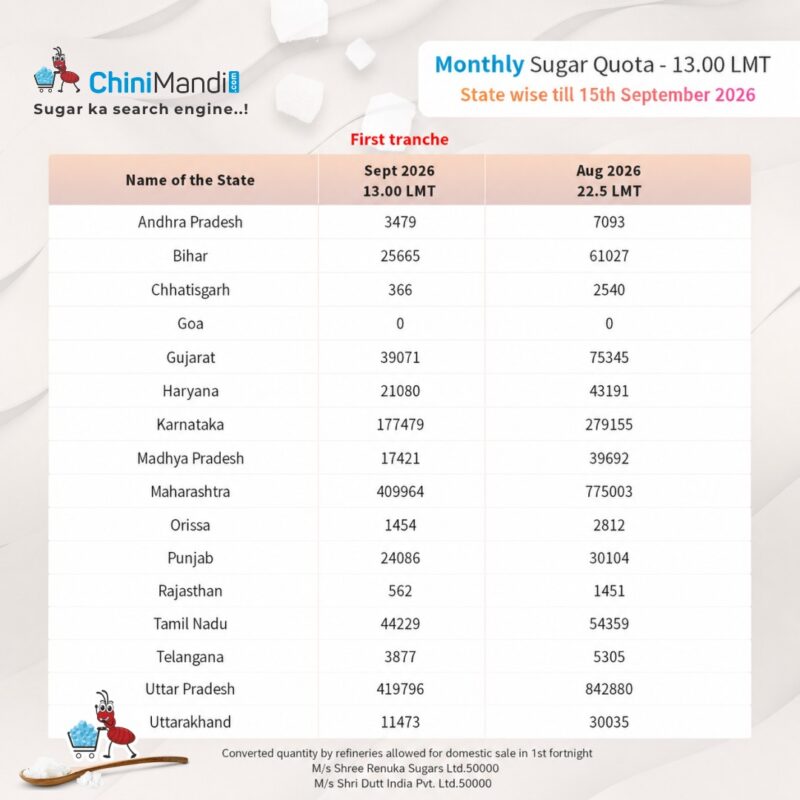
India’s Food Ministry allocated a 13 LMT sugar quota for September’s first fortnight to 587 mills and two refineries, requiring 40% sales in week one. Uttar Pradesh and Maharashtra received the largest shares. Strict stock verification, seven-day dispatch and reporting rules aim to ensure supply and curb price volatility.
In a notification released on August 30, the Food Ministry allocated a fortnightly sugar quota of 13 lakh metric tonnes (LMT) for first fortnight of September 2026 to 587 sugar mills and two refineries.
In September 2025, the government had allocated a monthly sugar quota of 23.5 lakh metric tonnes (LMT) which was similar to the quota allocated for September 2024.
In August 2026, the government had allocated a monthly sugar quota of 22.5 lakh metric tonnes (LMT) which was equal to the quota allocated for August 2025.
In July 2026, the government had allocated a monthly sugar quota of 22 LMT for domestic sale.
Under the fortnightly quota, mills will be required to sell at least 40% of the allocation in the first week and remaining quantity in the succeeding week.
The fortnightly allocation for September comes as the government continues to regulate sugar availability in the domestic market through periodic sales quotas.
The quota mechanism is aimed at ensuring adequate sugar availability and preventing sharp fluctuations in domestic prices. Market conditions and demand will remain key factors in determining sugar prices during September.
According to the experts the September fortnightly sugar sale quota is sufficient to tackle the domestic demand and the trend is likely to remain sideways to negative in the first fortnight of the September. Owing to the festival seasons, demand for sugar traditionally rises during this time due to higher consumption by households, sweet manufacturers and the food processing industry.
As per the order, individual limits were computed on the basis of each mill’s opening stock as on September 1 plus production during the fortnight, subject to a ceiling specified for every unit.
Uttar Pradesh received the largest share at about 4.20 lakh tonnes, followed by Maharashtra at around 4.10 lakh tonnes and Karnataka at 1.77 lakh tonnes, the order showed. Tamil Nadu, Gujarat, Bihar and Punjab were allotted quantities ranging between roughly 24,000 tonnes and 44,000 tonnes, while the remaining states, including Madhya Pradesh, Haryana, Telangana, Uttarakhand and Odisha, accounted for smaller volumes. Separately, refineries run by Shree Renuka Sugars Ltd and Shri Dutt India Pvt Ltd were permitted to sell a combined one lakh tonnes of converted sugar during the period.
All mills were asked to submit details of opening stock, production, dispatch, release and closing stock for the fortnight by September 18, 2026, through a designated online form, and to ensure that sugar sold is dispatched within seven days, with GST bills to be cross-checked during a special joint inspection drive by central and state authorities.
The order also required mills to submit their monthly P-II return for August 2026 through the API by September 7, 2026, failing which they risk losing allocation for the next fortnight. Closing stock as on August 31, 2026, declared in the P-II, will be verified during a physical stock verification drive, and any discrepancy will be treated as a violation of the Sugar (Control) Order, 2025, read with the Essential Commodities Act, 1955. The order noted that show cause notices have already been issued to mills that submitted false or incorrect information in their P-II returns for July 2026, with further action to follow under the Act.
Group companies operating more than one sugar unit may maintain stock either unit-wise or on a consolidated basis, the order said.
All the sugar mills have been directed to ensure the compliance of mandatory packaging of 20% of sugar in jute bags under Jute Packaging Material (Compulsory Use in Packing Commodities) Act, 1987 and submit the information thereof in P-II proforma on NSWS portal. Any violation of this order would attract the penal provisions under the Essential Commodities Act, 1955, as amended from time to time.
To Read more about Sugar Industry continue reading Agriinsite.com
Source : ChiniMandi