Sugar, SAF and bioplastics could shape india’s next phase of bioeconomy growth: Stefan Barot of Balrampur Chini Mills at SEIC 2026

India’s sugar and bioenergy sector is shifting beyond ethanol towards SAF, bioplastics, PLA and biomass-based products. Industry leaders at SEIC 2026 said scaling production, recycling waste, improving biomass infrastructure and localising technologies can strengthen sustainability, reduce imports and position India as a global bioeconomy hub.
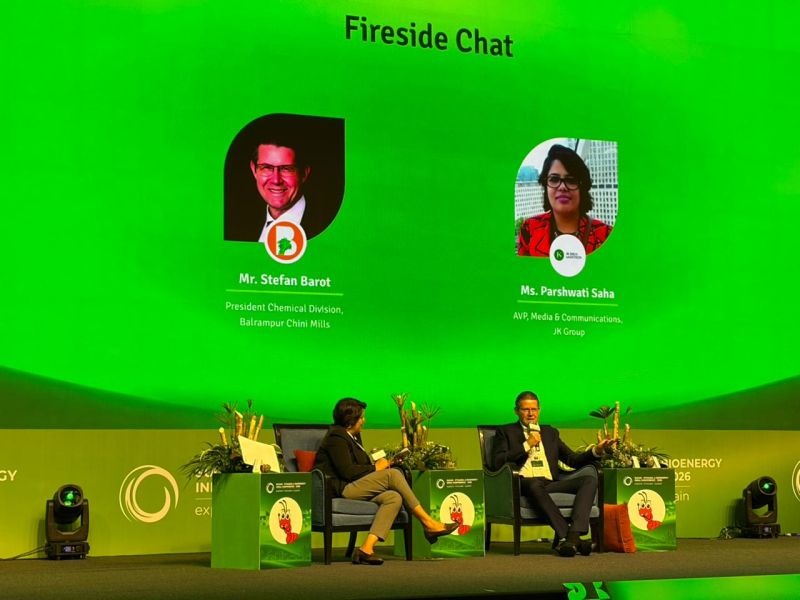
Mumbai: India’s sugar and bioenergy sector must move beyond conventional fuel production and focus on developing sustainable fuels, bioplastics and biomass-based industries to unlock future growth opportunities, according to Stefan Barot, President – Chemical Division, Balrampur Chini Mills, during a fireside chat at the Sugar Ethanol Bioenergy India Conference (SEIC) 2026.
The session was conducted in an interview format by Parshwati Saha, AVP – Media & Communications, JK Group, and focused on emerging opportunities in the bioeconomy and the role of innovation in creating long-term value.
Speaking during the discussion, Barot said products such as Sustainable Aviation Fuel (SAF), bio-based chemicals and advanced materials will play a significant role in reshaping future industrial and energy markets.
He said sugar and SAF have the potential to become strategic products in the global energy transition, while Polylactic Acid (PLA) is expected to emerge as an important contributor to this transformation.
Barot said India should initially focus on building domestic demand and industrial capabilities rather than prioritising exports of bioplastics.
According to him, waste management itself presents a major opportunity for India to strengthen its bioeconomy and create new value streams.
He noted that the development of PLA has involved several operational and commercial challenges, but expressed confidence that scale would improve competitiveness.
Barot said increasing production capacity would help lower manufacturing costs and make bio-based products more commercially viable.
Discussing biomass utilisation, he said agricultural residues should increasingly be treated as industrial feedstock rather than being consumed through traditional practices.
Referring to bagasse, Barot observed that simply burning it does not maximise its economic potential and that the material can be utilised for higher-value production.
However, he noted that infrastructure limitations remain a major challenge.
According to Barot, transportation and supply chain constraints continue to affect large-scale biomass utilisation and investment.
He said India has the potential to emerge as a biomass powerhouse if the required infrastructure ecosystem is developed.
Barot also linked the growing interest in biofuels to recent global geopolitical developments and changing energy priorities.
He said international uncertainty has reinforced the importance of energy diversification and accelerated interest in renewable fuel pathways.
According to him, India should identify chemicals that are currently imported in large volumes and explore bio-based production routes to reduce import dependence.
He added that adapting available global technologies to Indian conditions will be essential to improve affordability and commercial viability.
Barot said India should focus on localising and optimising technologies so they become economically sustainable for domestic industry.
The discussion reflected growing confidence that India’s sugar and bioenergy sector can evolve into a broader bioeconomy ecosystem by combining local feedstocks, technology adaptation and value-added manufacturing to support long-term growth and self-reliance.
To Read more about Ethanol Industry & Bio Energy News continue reading Agriinsite.com
Source : ChiniMandi