Industry looks beyond ethanol as PLA, biotechnology and circular economy gain momentum at SEIC 2026

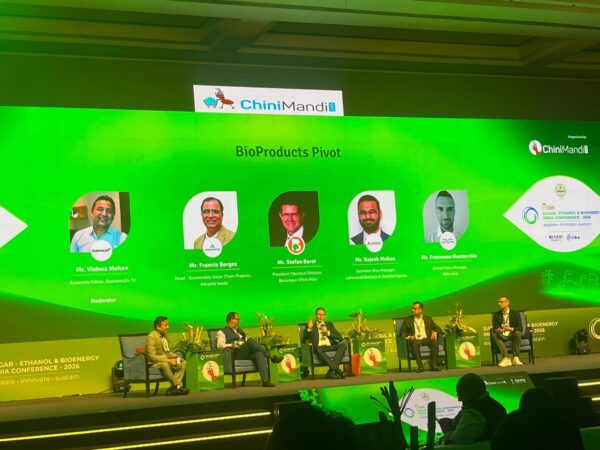
At the Sugar Ethanol Bioenergy India Conference 2026 in Mumbai, industry leaders highlighted diversification beyond ethanol into PLA, CBG, DDGS and SAF, stressing circular economy models, biotechnology innovation, export potential and integrated bio-product value chains to boost sustainability, farmer incomes and long-term competitiveness.
Mumbai: As India’s sugar and bioenergy industry enters a new phase of diversification, industry leaders and technology experts highlighted opportunities beyond ethanol and emphasised the growing role of bio-products, advanced materials and circular economy models during a panel discussion titled “BioProducts Pivot” at the Sugar Ethanol Bioenergy India Conference (SEIC) 2026.
The discussion session was moderated by Vishwa Mohan, Associate Editor, Business24 TV, and focused on emerging opportunities in Polylactic Acid (PLA), Isobutyl Alcohol (IBA), Distillers Dried Grains with Solubles (DDGS), Compressed Biogas (CBG), Extra Neutral Alcohol (ENA), and the potential for auxiliary revenue streams to become mainstream business segments for the sugar and bioenergy sector. The session also explored domestic and export market opportunities for bio-based products and fuels.
Opening the discussion, Francis Borges, Head – Sustainable Value Chain Projects, Advanta Seeds, said India has sufficient feedstock resources and should focus on building integrated value chains that extend beyond fuel production.
Borges said future applications should increasingly target alternatives to single-use plastics and other value-added bio-based products.
“Our target applications are single-use plastics. India has enough biowaste. Secure your feedstock, create ethanol and build bio-products that have opportunities in the global market,” he said.
Highlighting opportunities at the farm level, Borges said cultivating sweet sorghum as a ratoon crop alongside sugarcane could improve farmer returns without requiring additional inputs, as it can be utilised for bio-production.
According to him, improved agronomy and higher biomass productivity can strengthen farmer incomes and support the growth of the bioeconomy.
Sharing an industry perspective, Stefan Barot, President – Chemical Division, Balrampur Chini Mills, said scale and circularity will be critical in making emerging bio-products commercially viable.
“Our intention is to build larger plants to bring costs down,” Barot said.
He added that the company is focusing on recycling and integrating waste streams into the circular economy.
“We are focusing on recycling to bring waste material into the circular economy,” he said.
Barot also observed that reducing dependence on single-use plastics requires broader participation beyond industry.
“Stopping the use of single-use plastic depends on society,” he said.
Referring to India’s long-term sustainability goals, Barot added that industries must align future investments with decarbonisation objectives.
“We have to map carbon streams up to 2070 and work keeping this in mind,” he said.
Speaking on the role of innovation and diversification, Rajesh Mohan, Business Area Manager, Lallemand Biofuels & Distilled Spirits, said biotechnology can help unlock greater value from agricultural residues and industrial by-products.
“Biotechnology can be used to convert biowaste and utilise it. PLA can generate more revenue for the sugar industry,” Mohan said.
He noted that diversification is becoming increasingly important as ethanol production capacity expands.
“Diversification is going to be the key as ethanol is in surplus now. Biotechnology will help in developing new products and diversifying revenue streams,” he said.
Providing an international perspective, Francesco Montecchio, Global Sales Manager, Alfa Laval, said India has the potential to emerge as a major export hub for bio-based products despite uncertainties in global markets and technology adoption.
“India can become a global export hub despite uncertainties and technological challenges,” Montecchio said.
He identified PLA as a strong opportunity area for the sugar industry and said future investments should remain aligned with long-term sustainability trends.
“We know our direction and we need to move towards products like ethanol and Sustainable Aviation Fuel (SAF). They should be our guiding compass,” he said.
Montecchio also emphasised the importance of strengthening partnerships with technology companies to accelerate innovation and improve competitiveness.
The discussion reflected growing confidence that the future of India’s sugar and bioenergy sector will be shaped by diversification beyond fuel into higher-value bio-products, creating new revenue streams while strengthening sustainability and export competitiveness.
To Read more about Ethanol Industry & Bio Energy News continue reading Agriinsite.com
Source : ChiniMandi