Indian wheat purchase gathers pace as M.P. mops up 2.5 million tonnes

India’s wheat procurement narrowed its deficit gap after purchases surged 51% year-on-year in early May, driven by strong buying in Madhya Pradesh. Punjab and Haryana also exceeded targets despite relaxed quality norms for rain-affected wheat, raising hopes of achieving the 345 lakh tonne procurement target.
The Indian government’s wheat procurement jumped 51 per cent in the past week to 44.14 lakh tonnes (lt) from 29.22 lt purchased in the corresponding period last year, helping the government to narrow the deficit gap. This was possible due to half of the quantity (out of 52 lt total grain purchased in the State so far) procured during May 1-7 in Madhya Pradesh. This has created hope for the Union government to achieve the target of 345 lt in 2026-27 season even as overall purchase still trails.
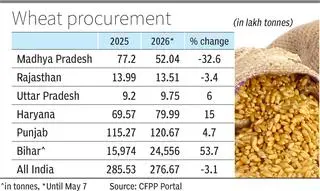
The Centre has procured 276.67 lt of wheat until May 7, 2026, down 3 per cent from 285.53 lt in the year-ago period (gap was 9 per cent until April 30 and 39 per cent until April 16). In Madhya Pradesh, it has narrowed the fall as it reached 52.04 lt, down 33 per cent from 77.2 lt a year ago. The fall in procurement in MP was 59 per cent until April 30.
Norms relaxed
According to the latest data, the procurement in Punjab reached 120.67 lt against 115.27 lt a year ago, up by 5 per cent. The Centre has fixed a target to procure 112 lt wheat from Punjab in 2026-27, against 119.19 lt bought in 2025-26.
Notably, almost the entire quantity in the current year’s purchase in Punjab was under relaxed quality (URS), due to widespread lustre loss in several districts due following unseasonal rains and hailstorms. Initially, due to some compilation error, the URS wheat quantity was showing negligible, but that has been corrected, sources
In Haryana, the Centre has purchased nearly 80 lt of wheat so far, exceeding the target of 72 lt, and is up by 15 per cent from 69.57 lt year-ago. In 2025-26, the Centre had bought 71.43 lt of wheat from Haryana.
The daily arrival on May 7 was 32,281 tonne against 97,731 tonne year-ago in Punjab and 9,463 tonne against 18,415 tonne year-ago in Haryana. There has been a substantial drop in arrival in both these states where the scheduled procurement period is till May 15.
Up in U.P., Bihar
The wheat purchase in Madhya Pradesh in the last seven days was 24.55 lt whereas in the corresponding period last year it was only 9.62 lt as the bulk of the purchase was made in April. The State government is under pressure amid farmer protests and tractor marches due to slow procurement. The matter was also raised by Agriculture Minister Shivraj Singh Chouhan with the State Chief Minister Mohan Yadav.
The wheat procurement has reached 52.04 lt in Madhya Pradesh until May 7, down from 77.2 per cent year-ago. The Centre has already raised the overall target in the state from 78 lt (fixed at the beginning of season) to 100 lt in late April. In 2025-26, the Centre had procured 77.74 lt of wheat from Madhya Pradesh.
The purchase in Uttar Pradesh has reached 9.75 lt against 9.2 lt, and in Rajasthan, at 13.51 lt from 13.99 lt a year ago, the data show. In Bihar, the procurement has reached 24,556 tonnes, up by 54 per cent from 15,974 tonnes year-ago. The Centre has also raised the purchase target in Uttar Pradesh from earlier 10 lt to 25 lt, in Rajasthan from 21 lt to 23.5 lt and in Bihar from 0.18 lt to 1.8 lt.
State procuring agencies have been asked to keep wheat procured under relaxed specifications (URS) category separately stored and accounted. Unseasonal rains in March and April led to higher moisture content in wheat grains, along with issues such as shrinkage and loss of lustre. As a result, a large portion of the crop was falling outside the prescribed quality standards, affecting the procurement process.
To Read more about Wheat News continue reading Agriinsite.com
Source : The Hindu Businessline