Kashmir loses nearly 40,000 hectares of paddy land in four decades

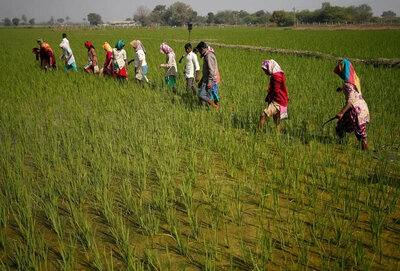
Kashmir’s paddy cultivation area has declined nearly 24% to 1.29 lakh hectares since the early 1980s, despite rice yields rising to 26.78 quintals per hectare. Urbanisation, crop diversification, water stress and changing climate conditions are reshaping the Valley’s traditional rice landscape.
Kashmir has lost nearly 40,000 hectares of land under paddy cultivation over the past four decades, a comparison of historical agricultural data and the latest Jammu and Kashmir Government figures suggests, pointing to a significant transformation of the Valley’s traditional rice landscape.
A study on cropping and land-use dynamics in Jammu and Kashmir, based on government agricultural statistics, recorded around 1.69 lakh hectares under paddy in Kashmir Division in 1980-81. By 2008-09, the area had fallen to around 1.14 lakh hectares—a decline of nearly 33 per cent.
“The acreage subsequently recovered to about 1.36 lakh hectares in 2017, according to a study based on J&K government statistics, before declining again to around 1.29 lakh hectares in 2023-24,” the data reads. The latest figure is reported in the J&K Government’s Economic Survey 2024-25, which provides district-wise agricultural data.
Taken together, the figures indicate that Kashmir’s paddy acreage is now roughly 40,000 hectares, or nearly 24 per cent, below the level recorded in the early 1980s. The decline in acreage, however, has not been accompanied by a comparable decline in productivity.
According to the J&K Economic Survey 2025-26, Kashmir’s average rice yield rose to 26.78 quintals per hectare in 2024-25, from 26.13 quintals in 2023-24 and 26.02 quintals in 2022-23.
The figures present a striking paradox–Kashmir is producing rice more efficiently from each hectare even as the area devoted to the crop remains significantly below its historical level.
The pressure on paddy land comes from several directions. Rapid urban expansion and infrastructure development have increased competition for agricultural land, particularly around growing towns and cities. Once fertile paddy fields are permanently converted for construction, they are difficult to bring back into agricultural use.
At the same time, farmers are diversifying their crops in response to market returns, climate conditions and water availability.
The J&K Economic Survey 2024-25 reads that around 1.40 lakh hectares of net agricultural land in Kashmir, excluding waterlogged areas, is being cultivated with mustard during winter under the Yellow Revolution initiative. “The shift does not mean mustard has replaced paddy hectare-for-hectare, but it highlights the changing use and intensification of Kashmir’s agricultural land,” it reads.
Water is emerging as another critical challenge. Paddy requires assured water at key stages of cultivation, making farmers particularly vulnerable to prolonged dry spells and erratic rainfall. Changes in snowfall, glacier melt and precipitation patterns are adding further uncertainty to the traditional agricultural calendar.
The transformation of the rice landscape carries consequences beyond crop production. Paddy fields support farming households, contribute to local food security and form an integral part of Kashmir’s rural landscape. They also provide open spaces that retain seasonal water and help moderate the impact of rapid urban expansion.
The historical figures therefore tell a larger story. Kashmir has managed to improve rice productivity, but it is doing so on a smaller cultivation base than four decades ago. As the Valley approaches another autumn harvest, the familiar golden paddy fields remain a defining image of Kashmir. But behind that image lies a changing agricultural reality—one in which fertile land is under growing pressure and water is becoming an increasingly uncertain resource.
To Read more about Rice News continue reading Agriinsite.com
Source : Rising Kashmir