Kharif sowing down 23%: El Nino hit monsoon takes toll on rice, pulses, cotton


India’s kharif sowing fell 22.7% to 182.72 lakh hectares by June 25 due to a 45% June rainfall deficit. Soybean acreage plunged 65.3%, oilseeds 53.3%, cotton 35%, rice 25%, while sugarcane rose slightly. Improved July monsoon remains critical for recovery.
The delayed and sluggish advance of the southwest monsoon has begun taking a visible toll on India’s agriculture, with fresh government data showing a nearly 23 per cent fall in kharif sowing across the country.
According to the latest figures released by the Ministry of Agriculture and Farmers’ Welfare, the total area under kharif crops stood at 182.72 lakh hectares as of June 25, compared to 236.46 lakh hectares during the same period last year.
This represents a decline of 53.74 lakh hectares, or nearly 22.7 per cent, highlighting the impact of below-normal rainfall during what is typically the peak sowing season.
The slow start to the monsoon has left large parts of the country with dry fields and inadequate soil moisture, forcing farmers to postpone sowing operations while waiting for widespread rains. India is reeling through a rain deficit of 45 per cent in June 2026.
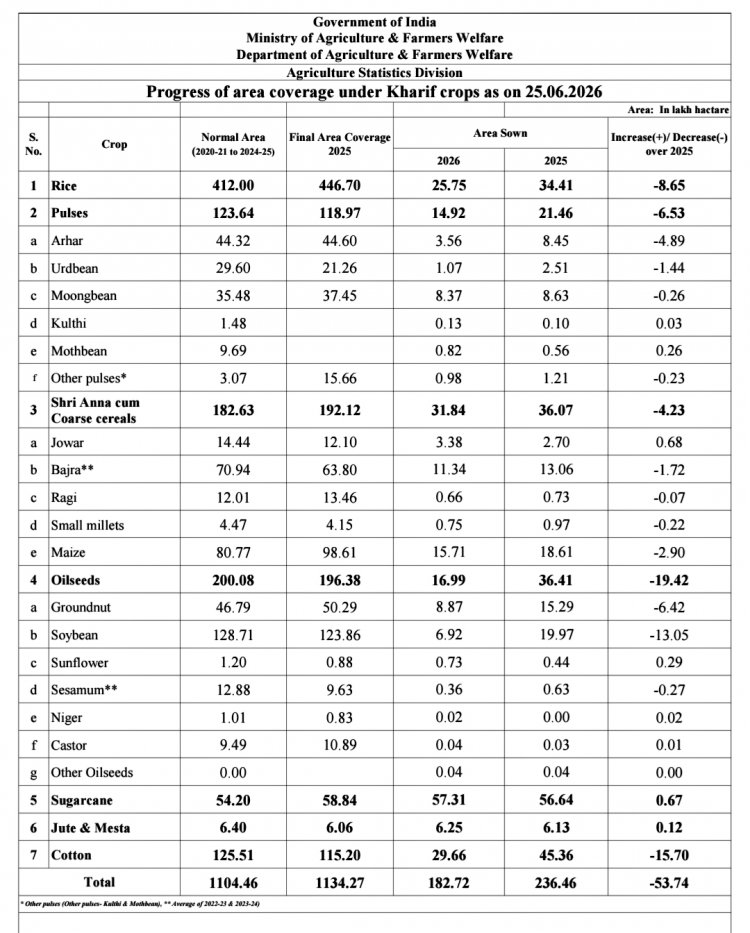
Rice, India’s most important kharif crop, has witnessed a significant setback. Paddy cultivation has covered just 25.75 lakh hectares, down from 34.41 lakh hectares a year ago, marking a decline of 8.65 lakh hectares, or around 25 per cent.
The situation is equally concerning for pulses, a crucial source of protein for millions of Indians. The total area under pulses has fallen from 21.46 lakh hectares last year to 14.92 lakh hectares this season. a decline of 30.5 per cent. Sowing of key pulse crops such as arhar (pigeon pea), urad and moong has lagged considerably behind last year’s pace.
The steepest decline, however, has been recorded in oilseeds.
Oilseed acreage has nearly halved, dropping from 36.41 lakh hectares to just 16.99 lakh hectares, a decline of 53.3 per cent. Soybean, India’s largest oilseed crop, has been the worst affected.
The crop has been sown over only 6.92 lakh hectares, compared to 19.97 lakh hectares at the same time last year—a massive 65.3 per cent reduction. Groundnut sowing has also fallen sharply by 42 per cent, raising concerns over domestic edible oil production in the months ahead.
Cotton, another major kharif crop, has also suffered due to the delayed rains. The area under cotton has declined from 45.36 lakh hectares last year to 29.66 lakh hectares, a drop of 15.70 lakh hectares, or nearly 35 per cent.
Sugarcane has been one of the few exceptions, with acreage increasing marginally from 56.64 lakh hectares to 57.31 lakh hectares.
Meteorologists expect monsoon activity to strengthen during the first week of July as low-pressure systems develop over the Bay of Bengal and the monsoon trough shifts southward.
Timely rainfall over the coming days could help farmers accelerate sowing, but if the deficit persists, it may affect crop yields, food production and rural incomes in the months ahead.
To Read more about Rice News and Edible Oil News continue reading Agriinsite.com
Source : India Today