Corporate oil palm plantation makes headway, import reliance to reduce

India’s domestic palm oil production is rising as oil palm cultivation expands under the National Mission on Edible Oils–Oil Palm. With private sector investment and growing plantations, crude palm oil output is expected to increase significantly, helping reduce import dependence despite elevated global edible oil prices and higher import costs.
While rising landed prices of edible oils, especially palm oil, are inflating India’s import bill and forcing local processing units to regulate import volumes, there is good news on the domestic front. Local production palm oil rose significantly in the last couple of years, with a host of private companies, including Godrej Agrovet, Patanjali Food and 3F Oil Palm venturing into large-scale oil palm cultivation.
Area under palm is expanded through a tripartite model between the government, farmers and these companies.
Acreage Expands Across States
Under the Rs 11,040 crore National Mission on Edible Oils –Oil Palm, close to 0.3 million hectare (Mha) has been brought under oil palm plantation in the last five years against the target of 0.65 mha. This enhancement of cultivated area is across 15 states including Andhra Pradesh, Telangana, Karnataka, Kerala, Odisha, Chhattigarh, Gujarat, Assam and Tripura.
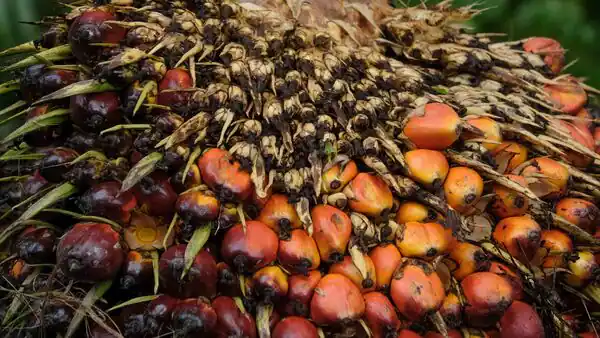
As a result, annual crude palm oil production from domestic sources is currently around 0.5 million tonne (MT). According to sources, once most of the new plantations start bearing fresh fruits bunches (FFBs) for extraction, the production will grow substantially, reducing import dependence to a great extent. It takes three to four years for an oil palm tree to bear fruit.
“From a yearly coverage of 21,292 hectare in FY22, over 84,000 hectare has been covered under oil palm cultivation in FY26,” an official told FE. The oil palm acreage is currently around 0.67 Mha. The official said that most private plantations reaching will full maturity in eight years and beag FFBs for next twenty-five yearsl.
High Import Vulnerability Drives
Trade sources said a rise in domestic production of palm oil would keep the rise in imports under check and cater to a steady rise in consumption. India imports around 57%-58% of its annual edible oil consumption of 25 MT to 26 MT. Palm oil imports account for close to half of the total cooking oil imports largely from Indonesia and Malaysia. Recently, the supplies of imported oil have taken a hit and prices surged, as producer countries have raised biofuel targets.
In the 2024-25 oil year (November-October) cooking oils imports were valued at $ 18.3 billion and are likely to exceed $ 19 billion because of elevated global prices of palm oils currently.
“Our total area under oil palm cultivation is currently 80,000 hectares across the country and the target is to take it to 0.14 –0.15 Mha over the next four to five years,” Sunil Kataria, CEO, Godrej Agrovet, one of the largest companies in terms of plantation cover, told FE. Patanjali food and 3F oil palm have estimated 90,000 hectare and 37,000 hectare under oil palm cultivation across 11 states respectively.
Kataria said that palm oil cultivation is five times more productive per hectare than oilseeds crops and once the first four years’ juvenile period for plantation is over, there is steady income for the farmers from productive plantation for the next 20–22 years.
The mission entails financial assistance for intercropping and inputs during gestation years, establishment of seed gardens, and provision of viability gap, funding for establishment of mills and assured buy-back of produce by industry partners.
The first phase of the five-year mission to reduce import dependence on cooking oils was approved in FY22 with Rs. 8,844 crore being the Centre’s and Rs. 2,196 crore contributed by the states. The scheme is likely to be extended further, sources said.
Sources said that mission was launched when Covid-19 disrupted supply of imported planting material. Against the requirement of 17.7 million saplings for the first two years’ coverage target of 0.11 lakh hectare, only 0.1 million saplings were available for covering 71,161 hectare under oil palm cultivation. Limited nursery infrastructure in the northeast affected availability of plating material hampered area expansion.
Andhra Pradesh, Telangana and Kerala are the major oil palm growing states, which accounts for 98% of the total production.
Currently, India produces about 44% of its domestic edible oil consumption requirement. Mustard (40%), soybean (24%) and groundnut (7%) are other oils who have a share in domestic production. The country also imports soya and sunflower oils, from Argentina, Brazil, Ukraine and Russia.
To Read more about Edible Oil News continue reading Agriinsite.com
Source : Financial Express