State-wise fortnightly sugar quota for sale in September 2026

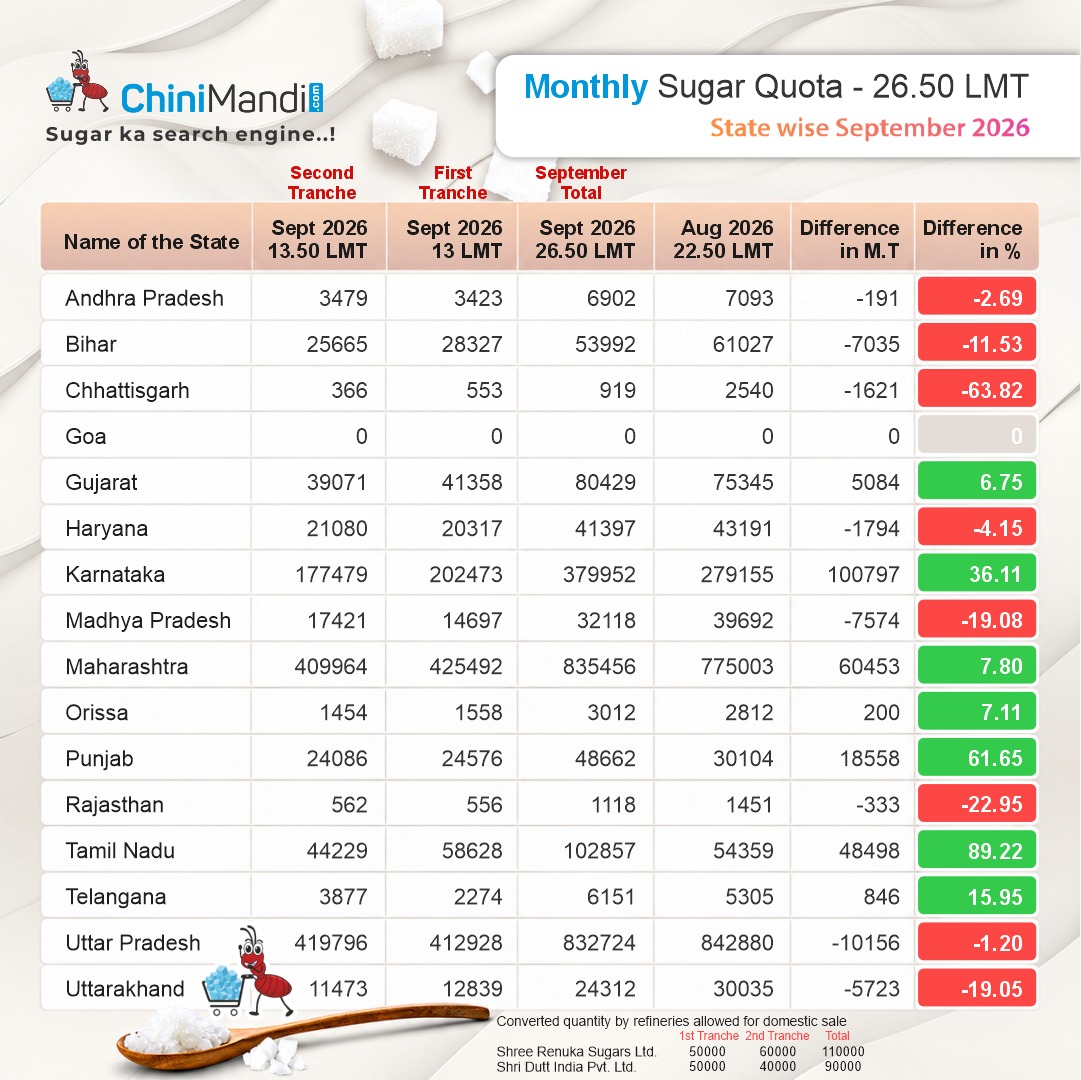
The Food Ministry has allocated a 13.5 LMT sugar sale quota for the second fortnight of September 2026, ensuring adequate supplies during the festive season. Maharashtra, Uttar Pradesh and Karnataka received the largest allocations. The move aims to stabilize domestic prices while enforcing stricter compliance, stock reporting and dealer registration norms for sugar mills.
In a notification released on September 15, the Food Ministry allocated a fortnightly sugar quota of 13.50 lakh metric tonnes (LMT) for second fortnight of September 2026 to 587 sugar mills and two refineries.
For first fortnight of September, the quota allocated for sugar mills was 13 lakh metric tonnes (LMT). In September 2025, the government had allocated a monthly sugar quota of 23.5 lakh metric tonnes (LMT) which was similar to the quota allocated for September 2024.
In August 2026, the government had allocated a monthly sugar quota of 22.5 lakh metric tonnes (LMT) which was equal to the quota allocated for August 2025.
In July 2026, the government had allocated a monthly sugar quota of 22 LMT for domestic sale.
This is the second fortnightly allocation for September which comes as the government continues to regulate sugar availability in the domestic market through periodic sales quotas.
The quota mechanism is aimed at ensuring adequate sugar availability and preventing sharp fluctuations in domestic prices. Market conditions and demand will remain key factors in determining sugar prices during September.
According to the experts the second September fortnightly sugar sale quota is sufficient to tackle the domestic demand and the ex-sugar mill prices in Maharashtra are likely to remain around Rs 4200 to Rs 4400 per quintal while ex-mill prices in Uttar Pradesh are likely to remain around Rs 4500 to Rs 4700 per quintal.
Owing to the festival seasons, demand for sugar traditionally rises during this time due to higher consumption by households, sweet manufacturers and the food processing industry.
Of the total quantity released, mill-wise allocations account for 12,49,999 tonnes, while the remaining 1,00,000 tonnes has been earmarked as converted quantity allowed for domestic sale by two refineries, M/s Shree Renuka Sugars Ltd, which has been allocated 60,000 tonnes, and M/s Shri Dutt India Pvt Ltd, allocated 40,000 tonnes.
State-wise, Maharashtra has received the largest allocation at 4,25,492 tonnes across 226 mills, followed by Uttar Pradesh at 4,12,928 tonnes across 123 mills and Karnataka at 2,02,473 tonnes across 81 mills. Tamil Nadu has been allocated 58,628 tonnes across 38 mills, Gujarat 41,358 tonnes across 18 mills, and Bihar 28,327 tonnes across 10 mills. Punjab’s allocation stands at 24,576 tonnes across 14 mills, Haryana at 20,317 tonnes across 14 mills, and Madhya Pradesh at 14,697 tonnes across 22 mills. Uttarakhand has been allocated 12,839 tonnes across 7 mills, Andhra Pradesh 3,423 tonnes across 16 mills, and Telangana 2,274 tonnes across 6 mills. Odisha’s allocation is 1,558 tonnes across 2 mills, Rajasthan 556 tonnes for a single mill, and Chhattisgarh 553 tonnes across 4 mills.
The order lays down detailed compliance conditions for mills. Under the fortnightly quota mechanism, mills are required to sell at least 40 percent of their allocation in the first week and the remaining quantity in the following week, with dispatch from the mill mandated within seven days of sale. The date of “sale” has been clarified to mean the date of generation or issuance of the sale invoice by the concerned mill, and the quantity covered by such invoices will be treated as the quantity sold for determining compliance.
The Directorate noted that several mills had reported being unable to sell their complete allocation under the first-fortnight quota for September 2026. Accordingly, it has been decided that any unsold quantity must be duly accounted for in the mill’s closing stock as on September 15, 2026, and that such lapsed quantity will not be permitted for sale thereafter, with no extension of the first-fortnight quota to be granted. Mills that could not sell their full first-fortnight allocation have been directed to submit a detailed explanation stating the unsold quantity and reasons for non-sale, while mills that sold in excess of their allocated first-fortnight quota have similarly been asked to explain the violation of the fortnightly stockholding limit. Both sets of explanations will be examined case by case, with further action to follow as warranted. These representations must be submitted by September 17, 2026, failing which appropriate action will be initiated against the concerned mill for non-compliance with the Sugar Control Order read with the Essential Commodities Act.
All sugar mills have further been instructed to submit complete first-fortnight sale details, for the period up to September 15, 2026, in the prescribed format by September 18, 2026, through their registered email ID via a designated Google form link, with the order cautioning that non-compliant mills may not be allocated any release for October 2026.
On dealer registration, mills have been directed to ensure their dealers register on the DFPD portal and declare their stock position every Friday as prescribed, verifying registration status using the dealer’s PAN or email ID. The order reiterates that no sugar mill shall sell sugar to any dealer not registered on the DFPD portal with effect from September 15, 2026, noting that login credentials for this purpose were already provided to mills vide a letter dated August 27, 2026.
Mills have also been directed to submit the monthly P-II return for September 2026, covering both fortnights combined, through the API by October 7, 2026. The closing stock as on August 31, 2026, as declared in the P-II return, will be verified during a physical stock verification drive, with any discrepancy to be treated as a violation of the Sugar Control Order, 2025, read with the Essential Commodities Act, 1955. The order further notes that show cause notices are being issued to mills that submitted false or incorrect information in their P-II returns for July 2026, with action to be initiated under the Essential Commodities Act on receipt of their replies.
Group sugar producing companies operating more than one unit have been permitted to maintain stock records either unit-wise or for the group as a whole. Additionally, all mills have been directed to ensure compliance with mandatory packaging of 20 percent of sugar in jute bags under the Jute Packaging Materials (Compulsory Use in Packing Commodities) Act, 1987, and to submit the related information in the P-II proforma on the NSWS portal.
The order has been copied to the concerned state governments and union territory administrations, MDs and CEOs of all sugar mills, the Indian Sugar and Bio-energy Manufacturers Association (ISMA) and the National Federation of Cooperative Sugar Factories (NFCSF), and has also been placed on the Ministry’s website.
To Read more about Sugar Industry continue reading Agriinsite.com
Source : ChiniMandi